MP1584EN KiCad Template & Module
01/06/2026
|
10 mins to read
|
Share article
MP1584EN KiCad Template & Module
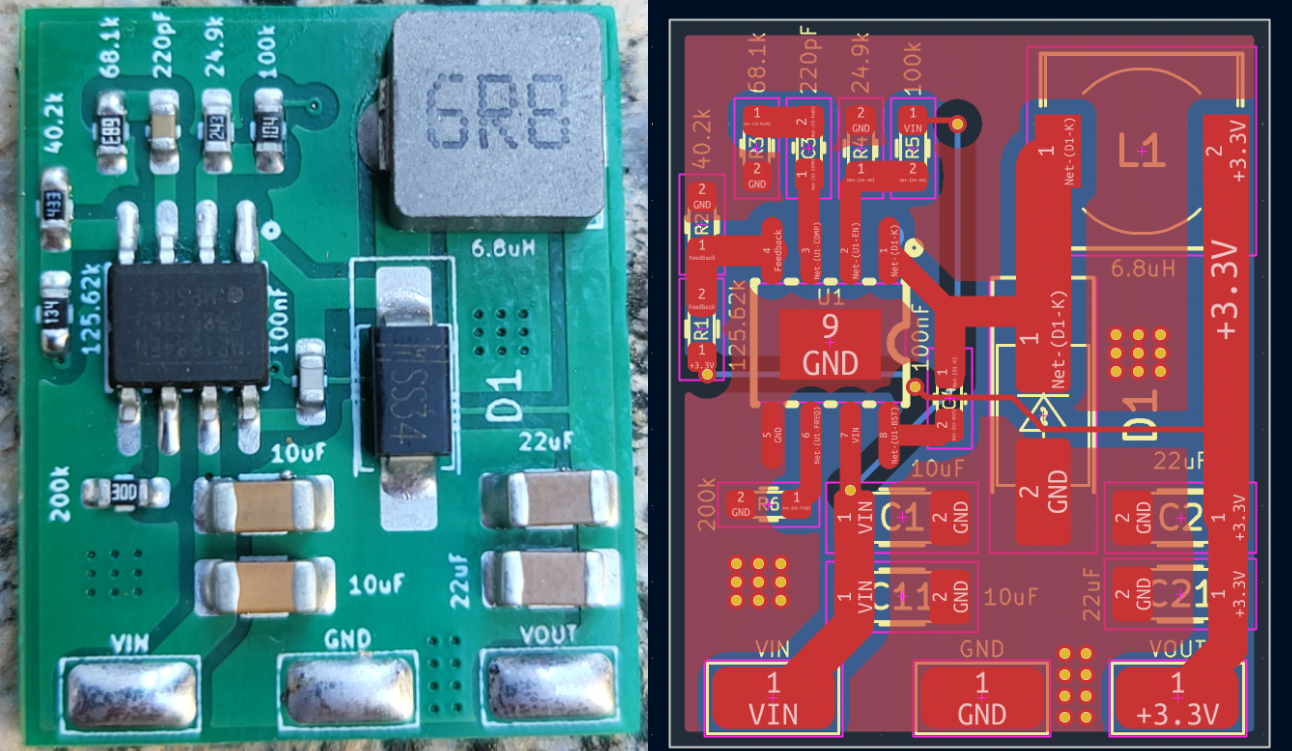
This project provides a custom PCB layout for the MP1584EN switching regulator, inspired by the manufacturer's recommended reference design while incorporating layout improvements to enhance performance, manufacturability, and ease of integration.
The board can be fabricated and used as a standalone buck converter module, or the circuit can be embedded directly into your own PCB designs to efficiently step down input voltages for embedded and electronic applications.
Module Features
- Input Range: 7.5V to 28V (See Module Design Notes - Enable Threshold)
- Max Current: 3A at the Output
- Measured Quiescent Current: 200μA
This design targets a 3.3V output and can be easily adapted to other output voltages by modifying the feedback network.
Integrate the module in your PCB project
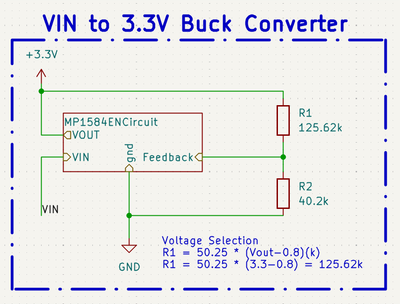
This project uses a hierarchical sheet structure to make the converter easy to reuse and configure. Parameters such as the feedback resistors (R1 and R2) can be adjusted directly from the parent schematic.
The recommended integration method is to import the converter as a hierarchical sheet and connect the VIN, VOUT, and GND signals. For PCB integration, simply update the hierarchical sheet path to point to the module schematic.
You also need to import the MP1584EN footprint library included in this repository.
Setting the Output Voltage
The output voltage is set using the R1/R2 feedback divider connected to the FB pin. A typical design uses R2 = 40.2kΩ, while R1 can be calculated as:
R1 = 50.25 × (VOUT - 0.8) kΩ
For example, a 3.3V output requires an R1 value of approximately 125kΩ.
In most applications, the resistor values do not need to be exact, as small deviations will only result in a minor change in the output voltage.
Bill of Materials
| Reference | Value | Description |
|---|---|---|
| U1 | MP1584EN | 3A Step-Down Buck Converter |
| L1 | 6.8µH | Power Inductor |
| D1 | Schottky Diode | 3A, ≥40V |
| C1, C11 | 10µF | Input Ceramic Capacitors |
| C2, C21 | 22µF | Output Ceramic Capacitors |
| C3 | 220pF | Compensation Capacitor |
| C4 | 100nF | Bootstrap Capacitor |
| R3 | 68.1kΩ | Compensation Resistor |
| R4 | 24.9kΩ | Enable Divider Resistor |
| R5 | 100kΩ | Enable Divider Resistor |
| R6 | 200kΩ | Frequency Set Resistor |
| R1 | 125.62kΩ | Feedback Resistor (3.3V Output) |
| R2 | 40.2kΩ | Feedback Resistor (3.3V Output) |
Note: R1 and R2 determine the output voltage and may need to be adjusted for output voltages other than 3.3V.
Soldering Process
Due to the size of the components, reflow soldering with solder paste is the recommended assembly method. The PCB footprint has been designed with sufficiently large pads, allowing solder paste to be applied manually in most cases without the need for a stencil.
With enough patience, good flux, and a fine-tip soldering iron, the board can also be assembled by hand, although reflow soldering will generally provide the best results.
Module Design Notes
Enable Threshold
The Enable Pin is driven by a voltage divider formed by resistors R4 and R5 allowing the module to only start when the supply voltage is greater than ≈ 7.5V.
Inductor Selection
A 6.8µH inductor was selected as a good compromise between output ripple, transient response, component size, and efficiency. This value is also recommended by the MP1584 datasheet for typical 3.3V output applications.
Capacitor Selection
The design uses two 10µF ceramic capacitors at the input and two 22µF ceramic capacitors at the output, providing a total capacitance of 20µF and 44µF respectively. Compared to the reference designs in the MP1584 datasheet, which typically use a single 10µF input capacitor and a single 22µF output capacitor, these values provide additional filtering margin and improved transient performance.
Using multiple capacitors in parallel also reduces the effective ESR and ESL, resulting in lower input and output voltage ripple, improved stability, and better high-frequency decoupling.
For output voltages other than 3.3V, refer to the MP1584 datasheet for the recommended inductor, output capacitor, and compensation component values.
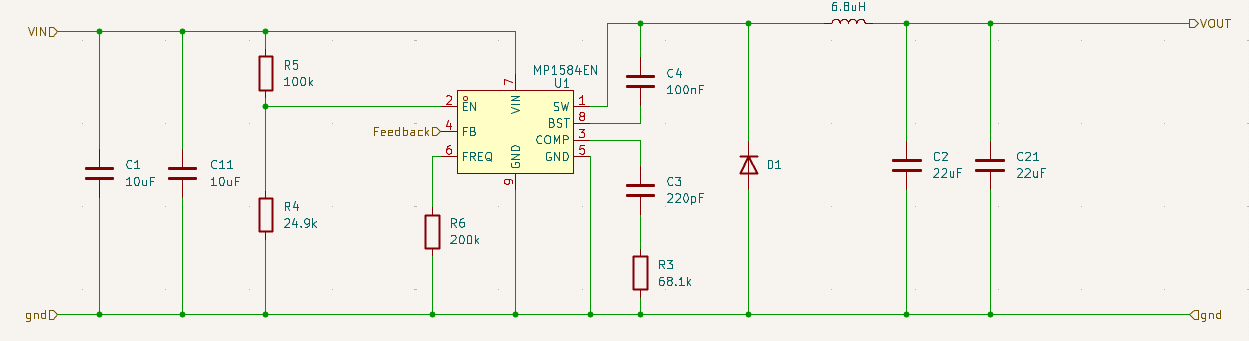
Circuit Design
License
This project is licensed under the MIT License.
THE SOFTWARE AND HARDWARE DESIGN ARE PROVIDED "AS IS", WITHOUT WARRANTY OF ANY KIND, EXPRESS OR IMPLIED, INCLUDING BUT NOT LIMITED TO THE WARRANTIES OF MERCHANTABILITY, FITNESS FOR A PARTICULAR PURPOSE, AND NONINFRINGEMENT.